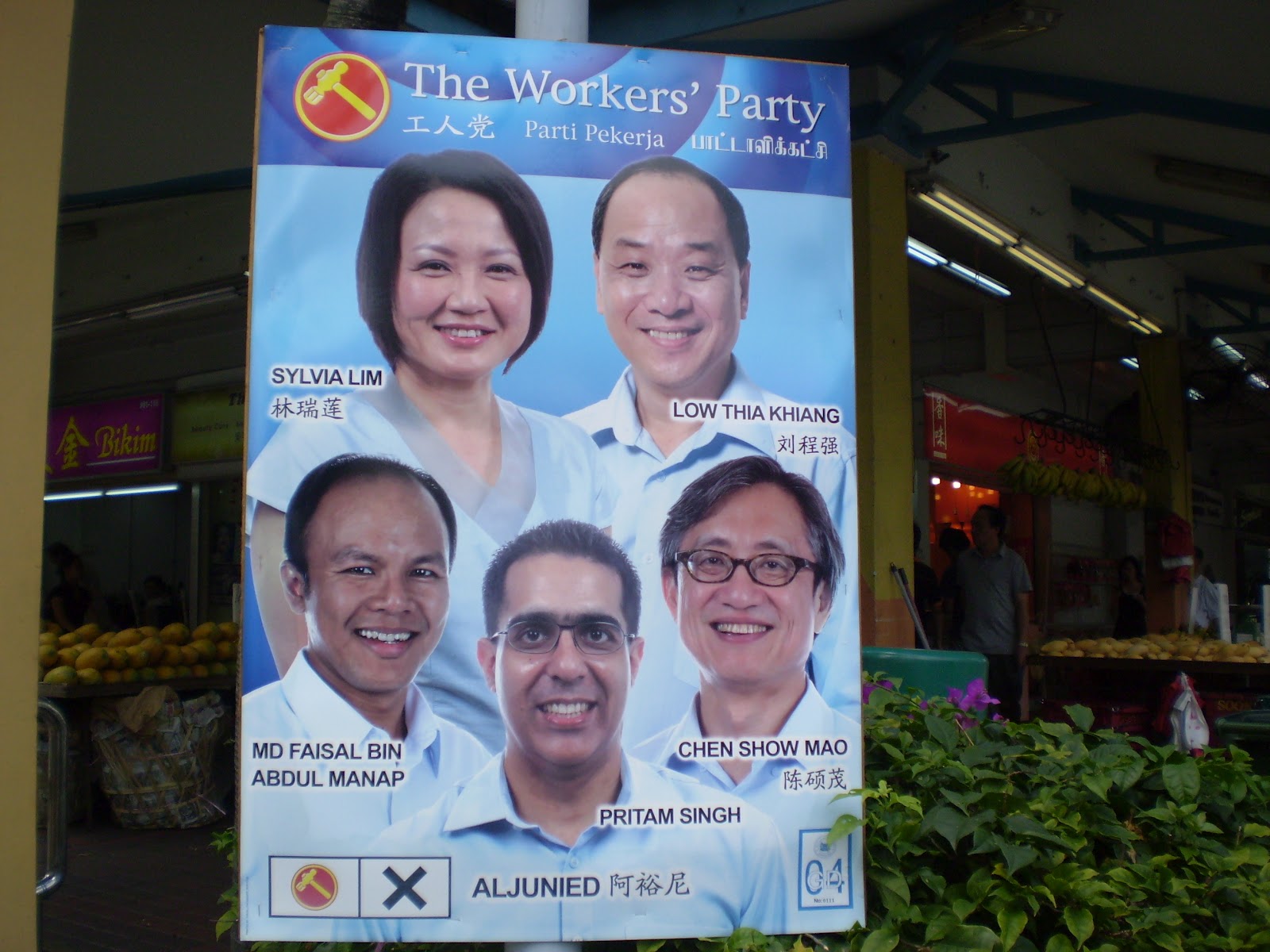
Showing posts with label WORKERS' PARTY. Show all posts

Friday, 22 February 2019

NEW INTERVIEW: My interview with Eric Tan (Workers' Party Treasurer / East Coast GRC team) (full text), 2010.

My interview with Mr Eric Tan (then Workers’ Party Treasure and CEC member / East Coast GRC candidate, 2006 GE), Singapore, 3 March 2010.
By: Dr Kieran James.
(Interview time: two hours.)

Kieran James: Q1: Explain the events in your life that caused you to become an opposition supporter.

Eric Tan: I was in banking industry for 13 years; graduated in Engineering from NUS [National University of Singapore], did national service; I thought joining the government is a good thing, the decision can help many people. I joined and I faced elitism through real-life situations. I joined as graduate. They never distinguished between scholars, I joined MINDEF [Ministry of Defence]; I left disillusioned as the civil service was not what I thought; the government promotes scholars; they don’t appreciate benefits; salary not much above private sector. We are giving them people to run the country, some want to migrate. I went to Michigan to do MBA, I was recruited by Continental Bank Illinois (now Bank of America) in Chicago then in Singapore; I joined PAP, not the party but CC – residents’ consultancy.
In 1987 they detained Marxists, first I gave government benefit of the doubt. Communism was diminishing as a threat [and as an] ideology. Priest went to Australia, said the bishop was cornered, did not want to say guilty. [Edgar] De Souza said the only thing guilty of was forming opposition party, wanting to mount a political challenge; in those days big fear factor. Maybe some underlying ambition; they got detained and smashed. I felt that was quite wrong; they got JBJ [Joshua Benjamin Jeyaretnam], government can’t stop fax returns; I got fax of Privy Court judgement. Michael Khoo acquitted JBJ; that was the right thing to do. You can exclude cheque from a list of assets as it [can] bounce. I agreed with Michael Khoo’s judgement. PAP would not have got money anyway. Khoo felt it was not an asset yet so he did not make false declaration. Of course he wanted to divert assets away; it’s a political thing not a commercial thing. He was taken out of Parliament. These two episodes [Marxist Conspiracy and treatment of JBJ] changed my mind about PAP.
PAP was good at economic policies but in the 1990s the economy was unravelling. I experienced the value of the Singapore Dream going down. In 1987 $300k for private apartment, house $400k, semi-detached; we want to buy such a house. In 1992 apartment worth $1 million, house $2 million; at peak my apartment $1.6 million, house $2.6 million; now: $2 million and $4 million. Singapore Dream is gone. I could have bought it in 1991, I personally experienced that. People down the chain could still afford HDB [back in 1991]. That prompted me to say I had to do something; Goh Chok Tong became PM; he said “Swiss standard of living”, it rang hollow.
In 1996 GE [held in January 1997], I helped Chia Shi Teck, independent campaigner. I couldn’t help JBJ or Chiam as SDP fell apart. I felt JBJ was done a great injustice but his style of politics was very individualistic, he’s like Elvis Presley, he represents [the] brand of opposition. Chiam was shaken by Chee episode. Chia, ex-NMP [Nominated Member of Parliament], Establishment guy, spoke the language we can relate to; it’s more capitalist, more mercenary values we try to promote. Chia lost badly 12% [actual vote: 14.1%], he was disinterested. I had low expectations, Chia did poorly; the people want party branding.
I met [Wong] Wee Nam – the opposition are not bicycle thieves, I know the bike thief man in Workers’ Party, the old man didn’t really steal a bike. I met Wee Nam; they had professional team [contesting in Hong Kah GRC for National Solidarity Party, NSP]. WP chief Low [Thia Khiang] said: “I can’t do anything, JBJ runs the show.”
In 2001 Low took over party; at last we have a vehicle. Wee Nam did not want to stand. Low is not [the type of] guy to approach people personally. Everyone felt Low and WP brand is best so we all went under WP umbrella. Poh Lee Guan stood in Yishun East [officially Nee Soon East SMC] for WP. I helped him 2001; I was not ready to stand. … In 2001 [we contested in] … Yishun East and Hougang. We only contested in two single wards, relegated to backroom of opposition. NSP [National Solidarity Party] took limelight with Steve Chia as NCMP [Non-Constituency Member of Parliament, awarded to best losing opposition candidate in Singapore general elections],
2001-6. CSJ [Chee Soon Juan] bungled up. In’06 everyone had low expectations of the opposition given all the mess. WP could capture imagination, 20 candidates, well-scrubbed, like PAP people; I contested East Coast GRC in 2006. I left banking two-and-a-half years ago; employers are not comfortable you join opposition politics. British boss said: “As long as it’s not BSP, I support you.” [Note: The BSP refers to the British Socialist Party which was only active from 1911-1920; probably this was misheard by me or by Mr Tan, perhaps British National Party or BNP was said by the British boss instead.]  Now I’m director of educational institutes identifying good people to join University of Michigan.
2006 WP rise from the ashes. I’m working hard to get elected, full-time job. Campaign for the GRC centred [on] James Gomez; he said he submitted his form [Minority Race Certificate]; Election Department could not find it; CCTV said he put them in envelope; they said he had evil intent; PAP could not prove; he said “honest mistake”; this brought fear factor back. 2001 they went after Jufrie [Mohamed Jufrie bin Mahmood]; [Jufrie] quoted Koran; they said he is trying to stir up racial feelings. 06 pick on James; we were disciplined; we stuck together; Low and Sylvia [Lim] handled it; press wants to draw you away from party line. Always defamation threat if you call me [i.e. anyone] a liar. We all stayed together; said WP will stay disciplined; we concentrated on campaign; we had different policies; campaign went like a pendulum; we felt the pressure.
We had three teams: Ang Mo Kio GRC, all young, hard for PM to bag [criticize] them; Aljunied, so-called A-Team, both Aljunied and East Coast [teams] had strengths and weaknesses. Sylvia had limelight, two businessmen [Goh Meng Seng and Mohd. Rahizan bin Yaacob], one banker [Tan Wui Hua], James, research guy. Ours [East Coast GRC] was MNC-driven, corporate executives, Brandon [Siow] with SIA, one was lawyer [Chia Ti Lik], Malay candidate Rahim [Abdul Rahim bin Abdul Rahman] in town council. Aljunied was a mix of executives and businessmen. We had candidates PAP would have [been proud of]. Aljunied has benefit of Hougang spillover. Press said A-Team, B-Team. We were sheltered from firing. We said Sylvia and Low will handle James’ case.
People were positive towards the campaign; [they] felt we had good candidates; WP got 36% [actually 36.1%] [in East Coast GRC]; expectations of people are low, not politicized; not ready for opposition. People said “36% is good,” I was disappointed. People [are] not politicized; East Coast was not contested until 1991 [actually 1997]. People were not rude; I had no negative reaction. We said: “You need checks and balances.” 
’06 WP was ahead of PAP. We did not come out looking back, after James’ affair. People are not politicized; people don’t think [that their] vote will make a difference to their life. Well-off people say “we will migrate”; less well-off people say “it’s my plight and PAP [is] not so bad”. PAP ideology over time has got away with saying “we know what’s best for you,” you are [treated] like [you are] a little kid. We believe people should be empowered to make decisions; this is the only way we can compete in the developed world. We lack risk-takers who can deal with uncertainty. PAP has their ideology. WP says: “It’s not working and not natural and no society became prosperous doing what we are doing.” You can’t deliver the goods so we want just to be happy serfs. I may be before my time.

KJ: Q2: What do you think will happen to Singapore politics in next 10-15 years and how many seats will the opposition win at next election [2011GE]?

Eric Tan:  Next election will be defining moment. PAP is going through a transition; this will probably be last election for MM [Minister Mentor, then Mr Lee Kuan Yew]. If opposition does not get ten elected seats, it will be fragmented and marginalized. If we get status quo, opposition cause will be tough. Next election PAP could break up. 1959, still some left-over Labour Front, nine or ten non-PAP MPs. 1963, then people disappeared, people who are capable, who want to be PM; this will finally come home to roost when PM goes, real ruthless guy, people may come out of the woodwork. Gomez issue brought back fear factor to voters. Intellectuals got angry, they are the converted. PAP brings back fear factor each election; they got the fear. Fear and apathy are hallmarks of PAP ideology; let hearts and minds of people decide. I like LHL [Lee Hsien Loong]; he’s nice man but different ideology. I hope WP gets at least ten seats, jury [is] still out, we only have one seat in Parliament. In next election another party could overtake us [but] we have market share now. If we don’t get market share we can also be fragmented. Fragmented opposition is not good; one opposition party needs to be marginalized so that other people can move with … [the strongest opposition party; I could not keep up with the speed of Mr Tan’s words here.]

KJ: Q3: Do you think there is a chance of a breakaway party splitting off from PAP?

Eric Tan: It looks like all in PAP are well-paid and compliant. PAP does not choose strong people who will threaten stability, all must accept the order of the universe; GCT was seat-warmer, people don’t choose political schemers. Hard to see breakaway but many keep feelings to themselves. Another faction not in cabinet, second echelon not visible to public, could mount breakaway; the thirties and forties age [group]. Strongman dies, the party tends to break up, history shows. There could be pent-up unhappiness that shows up later, that can still happen, you can’t dismiss the possibilities. Beyond next election we can’t predict; it depends on people in their thirties now. My mission is to make a breakthrough in the elections. I’m adding stability to Singapore; I’m trying to make WP stable so new group does not come in with uncertain branding. Those coming to WP need the same ideology.
KJ: Q4: What do you think are the strengths and weaknesses of the opposition parties?
Roderick Chia on the Monday after May 2011 GE.
Eric Tan: Part of WP ideology is we don’t speak badly about other opposition parties or PAP in public. We feel we are all on the same side of the fence but we don’t need to support them. They are different branding; SDP is western style engagement, pressure groups, protests outside parliamentary system as they feel that parliamentary system is unfair. This approach does not go down well with Singaporeans; they are not politicized; tell them you can do something with [their] votes; they don’t know their political rights. CSJ uses Hong Kong style, put pressure; get what you want. People are not ready for it. SDP brought down opposition cause, people are influenced by SDP actions that opposition is dangerous, a bull in a china shop. I have a right to say [that] I want to differentiate the branding. There is a split because of SDP although ideally we should work together.
KJ: Q5: What do you think of Singapore Democratic Party Youth and internet political activism?
Eric Tan: There are young activists, internet world; real-world. A lot don’t read internet, thirties and forties. We [WP] connect, we work hard, we knock on doors, we are brute force; they are high-profile. We are not as aggressive as SDP but Singapore people don’t want to destabilize PAP; people [are] not at the point [where] they want to change government. SDP imposes strong cures; [but] you have to convince people [that] life can be better; it’s not like Mandela during apartheid. … We have Facebook connections, not as active; SDP has nice website, ours is more passive; we have other mediums, we have got two contrasting parties and leaders; everyone does their own thing. Chee and Low are night and day. SDP is the big-bang approach; “we tell you this,” “you come to us,” “it was us all along,” but have they the skill-set to run a country or a town-council? I wish younger guys come and use us as a vehicle. They may feel we are boring farts and join SDP; that’s life, so be it.
Our content style is mainstream; Chee says: “This is my agenda and we don’t care [about] the rest of you.” WP has a strength as Low is Chinese-educated; you have to pay your dues. You need to get a set-up of people who collectively believe in ideas and act on it and make it happen as a group. You need to make it happen. We don’t just need more ideas. I hope one day there will be a breakthrough.

KJ: Q6: What do the opposition parties need to do to go from 25% to 50.1% and what type of people make up that next 25% that the opposition must win over?

Yaw Shin Leong and Kieran James, 5 October 2011.
Eric Tan: The old days, the bottom 20% or 30% are mostly the underclass and minority population. After 1991-Eunos GRC, [PAP] almost lost [final vote-count was: PAP 52.4% defeated WP 47.6%]; PAP knew they nearly lost; underclass was huge. GCT focused on this group; it shrunk from 35% to 20%; there will always be this 20%; we must capture the middle-ground as that’s how to change the country; we have to look at the middle group; they are not in love with us. We get 25%, we need them, PAP has maybe 30% diehards; they really believe PAP policy is good for them, we respect that. Next 20% or 30% is upper middle-class who can see through the deceit; [people] who can see that life will be tougher next 10-20 years; we want to cultivate them. PAP gives a lot of benefit to underclass now, hard to convert them; three or four-room flat people are for you or against you and fear factor is very high. This depends on PAP policy, [it’s] not within our power to convert them. You need to show them you have sincere and credible people. Next group is landed and condo people; PAP look at very top and very bottom end; upper middle-class is next group, less fear factor; I hope we can convince them; I think we have a chance; Chee may be looking for this group too.

KJ: Q7: What are the main Workers’ Party values?

Eric Tan: Main WP values are egalitarian society with more social [safety] nets; we believe in justice and fair-play and fewer monopolies; and anti-trust group to see that GLCs don’t bully SMEs. We believe in lowering cost-of-living in Singapore for essential goods; transportation should be cost-recovery; PAP style is to make money.

KJ: Q8: Would you call the party’s ideology socialist?

Roderick Chia, Dr Kieran James, Jarrod Luo.
Eric Tan: To some extent socialist; we are centre-left; we think PAP infrastructure is not so bad or we would not have become prosperous. Chee is in his [own] world. I chose this path for my personal reasons and I should not hold it against the whole society that it owes me a living. I’m not a hero or anything like that. You cannot doubt [that] LKY loves Singapore first but maybe it was [also] convenient for his own ambitions. The agendas coincide. He wanted to create something for his own ambitions. He thought he might be PM of Malaysia; he wanted Malaysian Malaysia. When I was young I thought he really loved Singapore but he played important role in making the country prosperous; you can’t take that away from him.
We need to work out what we need for Singapore going forward. I’m against the elite-creation model, it’s unnatural, I saw it in MINDEF; … we are unnatural, you can’t do it the way the rest of the world does? It’s all competition of ideas. 1959, left-wing was strongest group, not necessarily communists; the Chinese-educated had grievances; it was hard to get jobs under British regime. Left-wing was unhappy and PAP left-wing captured that group. They knew [that] PAP would win in 1959 but they work with LKY. They set up WP and they needed someone who would look like LKY; they chose David Marshall as front guy; they came from same group of people as PAP. LKY said communists controlled PAP, WP. He said he wanted one WP member to step down and it happened. 1963, WP became redundant and Marshall resigned. Barisan Sosialis took up the cause. Chinese-educated WP was going to give announcement in Chinese; there was mistranslation about agreeing to merger terms. Marshall resigned and party became dormant for many years. Left-wing group thought [there was] no use for it. 1971, JBJ took over the party until 2001; branding was JBJ, confrontational; need for opposition; light in the darkness. Chee sees rise in Christian megachurches. I didn’t agree with Chee destroying SDP; he thought of himself and not the cause; why not start a new party? Chee, Jurong 24% [actually SDP, headed by CSJ, scored 20.2% in Jurong GRC at 2001GE]; Steve Chia did better [scoring 39.6% in Chua Chu Kang SMC at 2006GE]; I knock on doors and 20% to 30% [of people] say: “don’t be like CSJ.”

KJ: Q9: What is the secret of Mr Low Thia Khiang’s electoral success?

Eric Tan: Low wins due to his sincerity; he gets back to basics; walks the ground; meets people and helps their issues; he does charity work but doesn’t want publicity; Chee is not like that. Low does not need the branding. Low did not visit funerals until after he was elected; they are a very sensitive thing; they see them as bad luck. If you come and you don’t come Chinese consider it very important; it’s a big deal because to go means bad luck. He was lucky to get in [Hougang SMC, 1991GE] but he held on to it. Chiam is like a childhood village head that makes the difference [all by himself]. Low’s thinking is that people want a PAP-style [of politics]; he does not want to look ridiculous; his style of branding is middle-of-the-road; he could not get Sylvia with the branding; his next challenge is to get us in.
Young people will not trust our branding; we probably have more activists than SDP. We visit the ground every Sunday; does SDP do that consistently? My daughters, Ann and Bernadette, then 15-year-old twins, had articles in there. [Note: Mr Tan is referring to the WP book Days of Being Wild published in 2006.]

KJ: Q10: Why do you think it is only Chiam and Low who are able to win seats?

Eric Tan: Chiam and Low had non-GRC window, 1984 and 1991; people were more politicized; they were credible; they [the voters] know there are no fears. The problem now is the GRC; he used upgrading threat. A big enigma, number one, as you say, [is] why Chiam and Low only win. If we learn this secret we can win.

KJ: Q11: Would you consider approaching Dr Wong as a potential WP candidate as part of a possible GRC super-team?

Eric Tan: Wong [Wee Nam] is not a pragmatist; he becomes irrelevant person; you need party discipline; he has not run again for election; super GRC team could not work.

KJ: Q12: Do you think the opposition should work harder to win over new migrants?

Eric Tan: 80%-90% of new migrants support PAP; mainland Chinese who come here know who butters their bread; they don’t want to upset people; their citizenship might be conditional on good behaviour. Whether SDP like it or not, Chiam and Low won elections; without winning an election you have no power-base and you have achieved nothing. So, Chee, win a bloody election!

****END OF INTERVIEW (12:20 p.m. on 3 March 2010)****

References cited here
Lam, Dana (2006) Days of being wild: GE2006 Walking the line with the opposition (Singapore: Ethos Books).

Wednesday, 21 June 2017

NEWS / OPINION: Workers' Party Statement regarding Lee family feud, 20 June 2017

Workers’ Party Statement, 20 June 2017
The Workers' Party believes the crux of the family issues surrounding 38 Oxley Road is for the family to resolve privately or in Court. We are only concerned with the allegations of abuse of power and the harm these have caused to confidence in Singapore and our political institutions. WP MPs have filed the following parliamentary questions to help clear the air on the allegations.
Pritam Singh: To ask the Prime Minister whether the Government would consent to a resolution to convene a Special Select Committee of Parliament, comprising Members from all parties, with public hearings that are broadcast live to look into allegations of abuse of power by the Prime Minister made by members of his family so as to allow his accusers to present all the relevant evidence to Parliament.
Sylvia Lim: To ask the Prime Minister (a) what rules are in place to ensure that Ministers and senior public office-holders with personal or pecuniary interests in the subject-matter of government decisions do not influence or participate in the related deliberations and decision-making, and how are the rules enforced; (b) as regards government opinions or decisions relating to the estate and assets of the late Mr Lee Kuan Yew, what conflicts or potential conflicts of interest did the government identify to exist from among the members of the Cabinet and with regard to the Attorney-General; (c) how these conflicts or potential conflicts of interest were or are being managed.
PNG ENG HUAT: To ask the Prime Minister (a) what clear rules and directives are in place to prevent Ministers and other political appointees from abusing their positions to access, influence and direct senior civil servants on matters beyond their professional course of work; and (b) how often are these rules and directives communicated to the senior civil servants and in what form.
Chen Show Mao: To ask the Prime Minister what mechanisms are in place to prevent, limit, detect, and address situations where ministers or other political appointees use state organs to obtain information not related to the performance of their duties, advance personal interests or punish detractors, critics, or political opponents.
Chen Show Mao: To ask the Prime Minister when should a minister or political appointee go to court to defend his or her reputation and when should he or she refrain from private litigation and seek instead to address such allegations publicly, such as in Parliament.
Leon Perera: To ask the Prime Minister (a) under what circumstances Ministerial committees whose existence is not made public are convened to address issues; (b) how many of such committees exist and can their terms of reference and composition be publicly announced unless forbidden by national security concerns: (c) in the case of the Ministerial committee reviewing the fate of No 38 Oxley Road, will independent heritage experts and processes for public opinion sensing be engaged by the committee.
Daniel Goh 吴佩松: To ask the Minister for Culture, Community and Youth (a) whether Deeds of Gifts executed with the National Heritage Board may be shared with third persons, and if so, under what circumstances they may be shared, (b) whether the Deed of Gift of items from 38 Oxley Road was protected by a confidentiality clause, and if so, why did the Board release the Deed to the Prime Minister.
[Source: Workers' Party Facebook page, 20 June 2017.]
Activist Roderick Chia celebrates Workers' Party wins at 2011 GE

Thursday, 3 September 2015

NEW INTERVIEW: My interview with Eric Tan (Workers' Party Treasurer) (interview summary and discussion), 2010.

Mr Eric Tan Heng Chong (former Treasurer Workers’ Party, former Member of Workers’ Party Central Executive Committee, candidate East Coast GRC for Workers’ Party 2006 and 2011 GEs)

Eric Tan stood for the Workers' Party in East Coast GRC at the 2006 and 2011GEs and served for a number of years as WP’s Treasurer. Eric was previously, and at the date of our interview, a member of WP’s Central Executive Council (CEC). He resigned the party, to the complete shock of informed commentators, shortly after the (7 May) 2011GE because his party chose not to award him the NCMP position in parliament (for “best losing effort”). Although he led the best performing opposition losing team, the party opted for renewal by selecting the much younger Mr Gerald Giam Yean Song, who was at the time aged 34. Mr Tan’s departure was a major loss for the WP because he was a calm seasoned campaigner and one of the few older people who had contested for the WP at both the 2006 and 2011GEs. Furthermore, his banking industry experience had given him the technical skills and expertise necessary to function effectively as a finance minister in government or as a shadow finance minister in opposition. Despite being such a serious loss for the WP his departure went largely unacknowledged and was basically shrugged off by the party like water off a duck’s back.

Mr Tan graduated from the elite National University of Singapore (NUS); completed compulsory National Service; and worked with the Defence Ministry (MINDEF). At this point he was still regarded as an “Establishment figure” and he viewed himself in the same way (source: interview with Eric Tan, 3 March 2010). At MINDEF Mr Tan said that he first became aware of the elitist meritocracy run by the PAP government (Barr, 2009; Barr and Skrbis, 2008) and he became increasingly disillusioned with the ruling party.

Mr Tan expressed his unhappiness about the government’s harsh treatment of opposition politicians and alleged dissidents especially in relation to JBJ and the so-called Operation Spectrum aka the “Marxist conspiracy” of 1987-88. He was also unhappy about the cost-of-living pressures that became more and more acute and damaging during the “Goh Chok Tong years” (i.e. during the years of the prime-ministership of Goh Chok Tong, 1990-2004). The NSP’s Goh Meng Seng agreed (personal interview, 15 October 2010), claiming that Goh Chok Tong’s gentle manner, as compared to LKY’s abruptness and occasional impoliteness, in fact meant swallowing a “sweet pill” as the government used more and more tricky hyper-capitalist methods such as Certificate of Entitlement (COE); Goods and Services Tax (GST); and Area Licensing Scheme (ALS) (now replaced by Electronic Road Pricing (ERP)) to engineer society and extract increased rents from the working-class.  

In sharp contrast to the SDP, which went into a period of relative decline after losing its three seats in 1997, the WP, after contesting only a few seats in the 1990s, raised its profile considerably at the 2006GE by contesting many seats and polling consistently well (without adding to its one elected seat). At the 2006GE, WP contested the following seven constituencies: Ang Mo Kio GRC; Aljunied GRC; East Coast GRC; Nee Soon East SMC; Nee Soon Central SMC; Joo Chiat SMC; and Hougang SMC; up from contesting only two SMCs in 2001. The WP wisely decided in 2006 and afterwards to focus its attention on contesting seats in the north-eastern part of the island, a region fast emerging as its “natural constituency” or its “heartland” (source: interview with Yaw Shin Leong, 5 October 2011).

The period 2006-13 was important in opposition history because it was the period when the WP became the first ever opposition party to gain a significant brand-factor meaning that a candidate having the WP-brand backing in itself was able to make a significant difference in terms of the votes polled. The SDP had begun this trend, on a smaller and less reliable scale, at the 1991GE when it won three seats (only to lose them all at the 1997GE when Chiam defected to the SPP and the others lost at the ballot box).

Mr Tan described the 2006 campaign at East Coast GRC for WP as follows:

“In 2006 everyone had low expectations of the opposition given all the mess. WP could capture imagination; twenty candidates, well scrubbed, like PAP people. I contested East Coast GRC 2006. I left banking two and a half years ago. Employers are not comfortable if you join in opposition politics. ... Now I’m director of an educational institute identifying good people to join University of Michigan. In 2006 WP rose from the ashes. I worked hard to get elected, like it was a full-time job. The GRC campaign centred around [sic] James Gomez. He said he submitted his [minority certification] form, the Elections Department could not find it; CCTV said he put them in an envelope [instead of submitting it]. They said he had evil intent. PAP could not prove; he said it was an honest mistake; this brought fear factor back. 2001 [actually 1991] they went after Jufrie [Mahmood]; they said he is trying to stir up racial feelings. In ‘06 they picked on James”.
Mr Tan stressed that the WP’s leadership consciously chose to exercise restraint after being criticized by PAP over the “James Gomez affair” where the WP’s Gomez was accused of being deceitful by claiming that he had submitted his minority race certificate to the Elections Department when there was no official record of its receipt. WP’s restrained approach was important so as to give PAP politicians and MSM journalists no further quotes to use as ammunition. The degree of restraint shown by WP’s leadership clearly impressed many people, and it is one major factor explaining WP’s electoral success in 2006 as well as the high regard in which the public held the party up until at least around 2013. Despite this, Gomez (personal interview, 10 January 2011) stated that, if he had been in WP’s leadership, he would have handled the affair differently. Basically, the PAP’s attempt to gain political mileage from the “Gomez affair” rebounded on itself. Patrick Lee (personal interview, 12 October 2010) told one PAP MP that its harsh politicization of the Gomez affair was, in his opinion, the primary reason why WP polled over 40% of the vote in Aljunied GRC. Mr Tan discussed the WP’s careful and restrained response to the Gomez affair as follows:
“We were disciplined; we stuck together. Low and Sylvia [Lim, Party Chairperson] handled it; press wants to draw you away from party line. Always there is a defamation threat if you call me [i.e. anyone] a liar. We all stayed together; we said WP will stay disciplined; we concentrated on campaigning; we had different policies; campaign went like a pendulum; we felt the pressure”.

The WP gallantly took on the PAP team in Ang Mo Kio GRC in 2006, a contest that looked unwinnable because of PM Lee Hsien Loong’s presence heading the Ang Mo Kio PAP team. Because WP had chosen to contest the PM’s GRC, the media coined the label “Suicide Squad” (敢死) to refer to the young six-member WP team. However, contesting Ang Mo Kio GRC actually made sound strategic sense since it is an area with a large ethnic Chinese population (that is far above the national average) and it geographically borders the Hougang SMC already held by the WP. It also includes part of the former Cheng San GRC contested by the WP team that included JBJ and Tang Liang Hong at the 1997GE, a team which performed extremely creditably ending up with 45.18% of the vote (44,132 out of 97,685 valid votes) (da Cunha, 1997, p. 131). Although the MSM happily reported the swing towards PM Lee in Ang Mo Kio GRC at the 2011GE (Lee, 2011), insufficient attention was paid to the fact that Lee contested against a strong WP team in 2006 but against a relatively weak and unpopular Reform Party (RP) team in 2011. The media in 2006 also referred to the WP’s “A-Team” (Aljunied GRC including lawyer Lim and researcher Gomez) and “B-Team” (East Coast GRC) although Mr Tan said that he did not like to put one team above the other.

At the 2006GE the WP polled very well in a number of seats including 33.9% against PM Lee’s team in Ang Mo Kio GRC (Lee, 2011). Significantly, Low’s share of the vote increased more than marginally in Hougang SMC from 54.98% (or 12,070 out of 21,952 valid votes) to 62.74% (or 13,989 out of 22,297 valid votes). It appears that the younger voters who came of age in time for the 2006GE were equally, if not more, impressed by Mr Low than the senior and middle generations. Overall, WP’s performances at the 2006 GE were as follows: Aljunied GRC 43.91% (58,593 out of 133,436 valid votes); Ang Mo Kio GRC 33.86% (49,479 out of 146,115); East Coast GRC 36.14% (37,873 out of 104,804); Nee Soon East SMC 31.28% (9,535 out of 30,484); Nee Soon Central SMC 34.63% (7,529 out of 21,740); Joo Chiat SMC 34.99% (6,580 out of 18,806); and Hougang SMC 62.74% (13,989 out of 22,297) (all calculations made by the researcher based on raw data at Singapore-elections.com). The sheer consistency of these results (by the standards of the day) reflected very well on the resurgent WP and showed that the party had built itself a hardcore supporter base of around 30-35% (rather than the historic 20% of “donkey” hardcore opposition voters referred to by Dr Leong). The WP was able to build upon these results at the 2011GE, with the party attracting both more committed hardcore support and more swinging voter support.

Mr Tan presented WP as a party intending to focus on bread-and-butter issues with little desire to broadcast its belief in so-called “abstract” concepts such as democracy and human rights. This is where WP’s approach (in the era of Low Thia Khiang as Secretary-General) differed significantly from that of SDP under Dr Chee. NGO activist Roderick Chia (personal interview, 4 March 2010), who assisted the WP team in Aljunied GRC at the 2006GE, put forward to the researcher a similar dichotomy. Although SDP’s Chee has covered in detail in his various books specific practical policy recommendations (further refined, as far as economic policy goes, in the 2010 SDP document It’s about you: Prosperity and Progress for every Singaporean), most or even all of these appeared to follow, more or less directly, from his personal humanitarian liberal-democratic beliefs. Although this may have begun to change, since around the time of the 2011GE, key commentators of the era perceived that the SDP then saw itself in the somewhat Gandhian or Mandelian terms of “light in the darkness” or “voice in the wilderness” (to quote Mr Tan). Whilst the Gandhianism and Mandelaism might have inspired many SDP members and supporters, Mr Tan argued that they did not gel with the Singapore reality nor did they resonate with socially and politically conservative voters. News reports of SDP’s strategic civil disobedience were especially badly received by this large segment of the voting population which might have been otherwise sympathetic to the opposition cause. Although Roderick Chia agreed with Mr Tan’s argument generally, he was, and no doubt still is today, “very critical of this ‘reality’ that [Singapore] society imposes on us” (source: personal e-mail communication to first-mentioned author, 16 March 2011). He went on to add that: “I believe in the SDP’s vision, really; it’s just that I don’t see it coming to fruition anytime soon” (source: ibid.). Regarding WP and SDP ideology and practices, Mr Tan commented as follows: 

“Part of WP ideology is we don’t speak badly about other opposition parties or PAP in public. We feel we are on same side of the fence [to other opposition parties] but we don’t need to support them. They [SDP] are different branding. SDP style is engagement; pressure groups; protests outside the parliamentary system as they feel parliamentary system is unfair. This approach does not go [down well] with Singaporeans; they are not politicized; tell them you can do something with your votes; they don’t know their political rights. CSJ uses Hong Kong style, put pressure, [and] get what you want. People are not ready for it. SDP brought down opposition cause, people are influenced by SDP actions [to think] that opposition is dangerous [or a] bull in a china shop. I have a right to say I want to differentiate the branding. There is a split because of SDP although ideally we should work together”.
In this interview response (cited above) Mr Tan indicated that he was careful and cautious about SDP. He did not believe that SDP’s approach is suitable for Singapore due to voters not being politically experienced or mature. Furthermore, he laid blame on SDP for causing voters to be afraid of opposition politics and for causing opposition disunity. This view is of course different to that of Dr Wong, Patrick Lee, SDP Assistant Secretary-General John L. Tan, and others who then attributed opposition disunity to the influence of PAP and MSM and to the allegedly authoritarianism ways of Mr Chiam. The WP’s ideological rejection of “Mandelaism”, a word introduced to us by Mr Tan, was probably the most important philosophical difference between SDP and WP during the years of WP’s rise, 2006-13.

The WP did not and does not necessarily present itself as anti-PAP but is more content to work with the government and to hold it to account much like an auditor does with an auditee corporation. The auditor analogy works well to describe how WP’s then two parliamentarians, the elected Low and the then NCMP Sylvia Lim, actually operated in the parliament. An auditor does not adopt a hostile attitude to the corporation being audited. Mr Tan stated that: “we think PAP infrastructure is not so bad or we would not [have] become prosperous” and “you cannot doubt that Lee Kuan Yew loves Singapore first, but maybe it was convenient for his own ambitions”.

Mr Tan (personal interview, 3 March 2010) pointed out that WP usually gets a strong result in the polls because it is seen as the last remaining living link to the sixties Chinese-educated left-wing and because its member JBJ was the first opposition member in the house after PAP regained total control of parliament in 1968. On this point, Roderick Chia wrote that: “personally I identify with JBJ’s legacy [to WP] more than the Chinese-speaking one” (personal e-mail communication, 16 March 2011). Mr Tan pointed out that the link to the old Chinese left-wing should not be understood only in conventional class terms since this grouping has seen its language and institutions progressively marginalized by the English-educated PAP faction since the early days of independence.

As to which group of voters the opposition must target to win more seats, Eric expresses his view on this topic as follows (emphasis added):“In the old days the bottom 20% or 30% [donkeys] are mostly the underclass and minority populations. After 1991, Eunos GRC, [PAP] almost lost; PAP knew they nearly lost the underclass. GCT [Goh Chok Tong] focused on this group. It [opposition vote] shrunk from 35% to 20%; there will always be this 20%; we must capture the middle ground as that is how you change the country. We have to look at the middle group; they are not in love with us. We get 25%, we need them; PAP has maybe 30% diehards; they really believe PAP policy is good for them; we respect that. Next 20% to 30% is upper middle-class who can see through the deceit; who can see that life will be tougher [for the] next ten to twenty years; we want to cultivate them. PAP gives a lot of benefits to underclass now, hard to convert them; three- or four-room [HDB flat] people are either for you or against you and fear factor is high; this [winning them over] depends on PAP policy; not within our power to convert them. You need to show them you have sincere and credible people. Next group is ‘landed’ [property] and ‘condo’ [condominium] people [upper middle-class, not necessarily ruling elite, includes first-generation nouveaux-riche]; PAP looks at very top and very bottom end; upper middleclass is next ground; less fear factor. I hope we can convince them. I think we have a chance”.  Mr Tan was realistic and circumspect when we talked in March 2010. He hoped for ten seats to be won for the first time in GE2011 by WP, bringing the number of opposition MPs to 12 (or 11 if either Potong Pasir or Hougang fell to PAP). Mr Tan’s prediction was only one five-person GRC too optimistic with Potong Pasir SMC being, of course, an opposition loss. Similarly, the SDP’s Chee reminded the researcher (personal interview, 14 October 2010) that the opposition has often hoped to see a positive trend in one constituency continue at the next GE but, historically, it has often been the case that the ground won is then lost again only to be counter-balanced by an unexpectedly strong result in another constituency.

[By Dr Kieran James, University of Fiji, formerly of University of Southern Queensland, 2006-13.]
Activist Roderick Chia celebrates Workers' Party wins at 2011 GE

Wednesday, 18 September 2013

OPINION: Half Way Bell Check on SG Political Parties - WP Part II, by Goh Meng Seng, 13 September 2013

The making of history - election campaign banner in Aljunied GRC, 2011

Half Way Bell Check on SG Political Parties - WP Part II

September 13, 2013 at 6:43pm
WP MPs C'wealth Parliamentary Conference Johannesburg.

It is always difficult for me to write an assessment or critique of Workers Party not only because it has apparently the largest "Internet Troopers" on New Media who would readily curse and swear at people who criticize WP but on top of that, I was once a member of its CEC.It will be a kind of internal struggle within me but since I have set to be truthful to myself and to the words I write, what have to be done, will be done accordingly. It is for the greater good of learning for our constant evolving and emerging democracy in Singapore. 

It was exciting for anyone who have worked decades for a better development of democracy in Singapore to know that opposition party WP has finally "made it" to break through the stranglehold of the GRC system which was deemed as the "impenetrable fortress" of PAP heavily guarded by its ministers. I was no exception to such excitement. However, barely six to eight months right after such historical breakthrough, reality started to set in for WP.
WP fought GE2011 with a rather "sexy" slogan "Towards First World Parliament" which actually lacks philosophical and ideological depth but it works and they won. At first look, it doesn't really  matter as long as they could win seats. However, things to fall apart when parliamentary sitting starts.

What is WP's Policy Ideological Stance?

First of all, it seems WP has flip flopped on its stance on Million dollar Ministerial Salary. It tries to use some technical terms like MX-9 without a full understanding that their approach will end up similar to PAP. It is a kind of embarrassment for WP trying to show that it has "alternative" and different from PAP but ended up like a side-kick of PAP instead. I really wonder whether WP has done a thorough internal policy exploration and debate or not before it went on to parliament to present its stance.This is especially important when its new maverick MPs try to "show off" their "intelligence" by embarking on a path that result in the upheaval of present policy stance, due diligence must be made.

The most horrified thing to happen in parliament is WP's stance on 6.9 million population direction. It just gave a "discount" to PAP's 6.9 million to 5.9 million. It is another glaring attempt of WP trying to show it is different from PAP by having some pseudo "alternative" without really understanding the real issues around them. Plucking figures from the air isn't going to show much credibility on WP's policy front. Their proposal is in effect, a 15% increase from the present population figures and I wonder if they really think Singapore could cope with a further 15% increase in population or not.

Apart from all these, the most unbearable thing to see is WP going into parliament to raise municipal issues of cats, dogs and bird droppings. Have they run out of idea or policy matters to talk about in parliament?

All these could be excused, said WP apologists, because WP MPs are new to parliamentary culture and policy debates. But I would remind them that WP SG LTK has over 20 years of parliamentary experience and Sylvia Lim is not new as well. They should have provided the needed guidance to their "green colleagues".

It is also important to note that WP lacks real team building and shared core political values. Well, we can't expect much from opposition parties at this stage because most of the time, even for TEAM A of the opposition party, it is only assembled at the very last minute. Most important of all, for some odd reasons, you don't really see the WP MPs giving active support to each other in parliamentary debates. Communication and intense policy discussions among key members is a very important way to get political stance clear and everybody stick to it instead of flip flopping during public forums and parliamentary debates. 

The most embarrassing contradiction and glaring fumble that exposed WP's apparent lack of Democratic ideology is the Vote Buying Saga in one of its HDB upgrading voting exercise carried out in its Aljunied Town. Lucky Draw for voting yes. Isn't this similar to PAP's strategy of vote PAP for HDB upgrading kind of pork barrel politics? Apparently WP only pays lip service to Democracy and attack PAP for vote buying just to gain votes. But when it comes to its own little management of a town, it would even go a step further by using privileged information of voters' preference (because it is not a secret ballot) to carry out its vote buying exercise! 

Integrity, Transparency, Accountability and Competency 

The unfortunate YSL adultery saga is the first major blow to WP. But apparently, the impact is very limited as the two by elections in Hougang and Punggol East have demonstrated that voters are unfazed  by such scandal. But up till now, due to WP's abrupt dismissal of YSL after keeping totally mum about the rumors, most Singaporeans will not know the truth at all. The truth may mean little to most people but the way WP handles this issue gives a glimpse on the opaque way WP deals with matters. It is unfortunate for an opposition party like WP who fights on the Democracy principles of Transparency and Accountability would end up tripping itself all over them. The only face-saving act was to sack YSL in double quick time when more evidence surfaced on the media to show that YSL has erred in his personal life.

Plagiarism is not acceptable in any field but apparently WP doesn't see it as a problem, even if it means suffering embarrassment when Pritam was exposed right in parliament. Apart from all these, there is also a small little drama of Secret Squirrel Saga happening right in the middle of Hougang By-elections which directly questioned WP Png Eng Huat's integrity when it shows documented WP internal CEC minutes that Png was listed as one of the potential NCMP candidate as contrary to what he has claimed.  

But these aren't the greatest evil yet. Town Council management and WP's managing agent FMSS seems to its biggest problem so far.

Town Council management used to be WP's Comparative Advantage against all other opposition parties but apparently it is loosing its plot over this field. First of all, the initial appointment of FMSS as its MA raise eyebrows. We have attacked PAP for giving out contracts and goodies to cronies but in the end, we find WP doing the same in its own backyard. So it seems that being FIrst World is to learn from PAP's First World bad practices in dealing with public contracts. But at the very least, when the Brompton bike saga blew up, PAP took actions against its errant civil servants.

WP's TC management was put in doubt for various issues:

1) For some reasons, the Independent Auditors didn't want to sign or comment on AHTC's account. This is rather unusual and we don't know why up till now. WP didn't offer any explanation at all and such opaque management style is really worrying.

2) WP blames some of its TC management problems to PAP's AIM. Although PAP's AIM saga involved politically motivated transactions, but apparently, from published documented emails, WP is supposed to have a smooth hand over since 2011. This was reiterated by WP's Sylvia Lim that there was a smooth transition. So it is quite puzzling to hear WP back tracking and blame on PAP for its own incompetency.

3) The most intriguing and disappointing happening is the Hawker Ceiling Saga. Here again, after it is apparent that there must be something wrong with FMSS management of the TC, inconvenient truths are just swept under the carpet. Accusations made against FMSS key manager insisting of additional payment was brushed aside while unsolicited quotation to the hawkers by its subcontractor was explained as "private deal"! It is really mind boggling  and when you thought LTK is going to do some serious investigation on this issue, a sudden twist happens and everything is quickly swept off and WP just pretends nothing happens. It is a typical incident that exposed doubtful integrity, non-transparent and total lack of accountability on WP's part. 

4) Dubious sacking of TWO pregnant women by FMSS within a year has put serious doubts on WP's political standing. Some have argued that FMSS is not WP but we must always remember that FMSS only serves WP's AHTC and WP is the boss that employed this management agent. If the MA it employs has bad management practices that contradicts the party's political philosophy or ideology like eradicating discrimination of women, single women, pregnant women etc, then it has the political moral authority to correct FMSS. But so far, nothing heard from WP on such standing.

Despite of all these failings hitting hard at the basic fundamental core values of WP's Integrity, Transparency, Accountability and Competency, I guess most die-hard opposition supporters and WP people would still pledge their support for WP. This is a big silver lining for WP. However, there might be a small group of well educated middle ground voters who will have their confidence shaken by all these happenings. But I guess this group will be quite insignificant, taking the two by-elections into account.

Political Ground Movement & Engagement

WP remains as the only opposition party which has the most consistent political ground engagement on the front. It is a strong tradition that keeps the party moving, consolidate and provide ground activities for their activists. At the same same, it also provides an important revenue source to pay rent for the party HQ.

WP also has the advantage of controlling the TC in which provides a platform for it to organize various activities for residents, like Durian Tours etc. On top of that, they have consistent door knocking and block parties.

These are tested and proven to be effective political work that will help to fortified their gains as well as opening up new frontiers.

Intra-party Dynamics

On the surface, Mr. Low TK seems to hold a tight ship. However there are signs that all are not well.

First of all, it is the matter of ethnic balance. The departure of Sajeev and Fazli, both candidates of WP in GE2011, has shed some light of the perceived "Chinese" image of WP. Some may argue that these are just exceptional cases but that is not all. WP tried to woo "minority members" by holding some talks specially for Malays but the attendance by non-party members was pathetic. It has tried to appease the Malay community and its members by promoting some of them to cadre members. It has also "elected" more Malays and Indians into its Youth Wing CEC. But the fact still remains, its recent "helicopter co-option" of three "elite" members into its CEC has further tilted the racial balance within its top leadership. 

The situation may aggravate if these members have seldom participated in any Hammer sales or door knocking. It is quite unusual for WP do a "helicopter co-option" of CEC members more than 1 year after its OPC. I remember back in the early days, they tried to co-opt a Malay lecturer but failed because the reason given was, WP should respect the will and votes of the cadres... well even when it is a good potential Malay candidate. Of course, the Malay lecturer left the party thereafter. 

Apart from that, it is fascinating to observe LTK being "over-ruled" subtly in the Hawker Ceiling Saga. He has openly declared that he want to find out who asks FMSS contractor ATL to send the quotation to the hawkers. But subsequently, he retracted his stance by saying there will be no more investigation done. Although LTK has stepped down as Vice Chairman of the TC but he is still the SG of WP and member of the Board of TC. When there are issues arising from the TC which will put bad publicity and doubts on the party, he will need to step in to clear it up. Thus, it really makes me wonder whether he is still in control of the party at all when he has to do a U-turn like this publicly.

Many view the co-option of the three CEC members as "good development" but I would see it as a signal that there is intense tension within the CEC so much so that LTK has to use co-option as a means to tilt the balance to ensure stability within. But such co-option will create more quiet discontent among cadres and party activists especially so when it is perceived as "elitist" without considering the party's culture of "merits" based on participation of ground work like Hammer Sales and Door Knocking. It will disillusioned them that WP is becoming too similar to PAP's management. It is not a good sign at all.

There has been long standing rumors about factional friction and even "fight" within WP but I would say that it would be foolish for anyone to rock the boat when all of them are sitting on its tip.

How is WP Performance so far?

Very disappointing. This is not just my assessment but some WP ardent supporters and even members who have put it plainly to me.

Chen Shao Mao has been "over-sold". He is the only one with "International Perspective" but he lacks depth in understanding issues in Singapore. This is why he could only go on lofty ideas but hardly any beef or insights on specific local issues. He may have well prepared speech delivered in parliament but as a lawyer, his debating skills is really agonizing. Although I don't like LKY at all but I have to agree with his observation of CSM, he is disappointing and cannot debate properly. It is a necessary but insufficient strength to recite a prepared speech properly in parliament. You need to be able to debate about it as well. 

Then we have the maverick smart alec type, Pritam Singh. There is nothing wrong if you want to use somebody's else articulated points and this has been done quite frequently in parliament. But the only decent thing to do is to credit the source or raise it as "I have read this point from a blog....etc". But if you try to make it sound as your articulated point, then you lose your plot and integrity as well. Not to mention how he went on to conduct the "Vote Buying exercise" in his ward for HDB upgrading poll which is really a brutal and cruel way of diminishing the very democratic values his party is supposedly fighting for. Of course, his fumble over publicly saying that WP will be ready to be PAP's coalition partner in a post-GE2011 forum is really premature. The worst part is his role in the Ceiling Saga which he responded with that kind of smart alec attitude. 

LTK is right that at present, WP is not ready to be the government yet. You may not need "elites", top lawyers or top scholars to form government but at the very least, you need people with REAL International Perspective and REAL Understanding of policy issues with indisputable integrity first before you can move forward to become ruling party. Apparently WP is very weak in this aspect. Sylvia Lim may be proficient in Legal issues while YJJ has good points in education policy, but that are about all they have. It would be very dangerous for WP to become ruling party with more of the likes of Lian and Huat. Nothing personal and nothing to do with "paper qualifications" but running ministries will need people with better ideas in policy matters. Learning from other countries is not a sin, but not knowing the issues and where to find solutions, will be devastating. 

Conclusions

WP will definitely continue to win popular votes and more seats in the coming elections. Their ground political activities and engagement is superb and will allow them to gain more seats. However, that is purely not enough for a political party to win seats but unable to deliver in parliamentary debates or proper running of TC. It is just not enough to become a "social club" kind of political party where the party focus more on social gatherings and activities rather than serious policy discussions and deliberations. 

Although it claims that it is not ready to be government, but it has to start somewhere, to groom itself to be a real alternative to PAP. It has to get its acts together, be it administrative running of its TC, policy debates in parliament, strengthening of their core values or just plain common sense. 

Even if WP is really like what Pritam said, wanting to be a coalition partner of PAP, it will have to make sure that it has the people with necessary learning and exposures to become ministers.

What WP needs to do at the moment are:

1) Strengthen its internal political education process. It is just not enough to fill up members' time with Hammer Sales, Door Knocking and various social gatherings (temper dinners, Christmas party and such). A political party like WP will have to start political education to keep its members and activists deeply rooted in policy stance, political ideology and beliefs.

2) It must start to set its standards of good governance starting from TC management. It is totally unacceptable to allow its MA to create unnecessary political embarrassment and incidents that contradicts the party's political standing. WP must be the one which lead and guide the MA in management principles and not the other way round. It has to act as the boss of FMSS instead of allowing it to pull its nose around. Keep it under control. 

3) It has to change its cultural mindset and change the perception of Malay and Indian communities if it wants to stay relevant to National political platform. Sense of Fairness and Justice is human inborn nature and you couldn't fool people all the time.

4) Integrity, Transparency, Accountability and Competency are easy slogans to shout about but definitely a heavy burden to practice. As an opposition, WP cannot lose the "Moral High Ground" by using the argument "PAP also like that" to justify its shortcomings. Worse still, learning those "legalized" but marred with all sorts of "conflict of interests" methods to run its daily business will definitely not give us any confidence at all. It has to set it straight and enforce a mechanism to get things right. Shying away from potential scandals and embarrassment by sweeping inconvenient truths under the carpet isn't going to help them grow. We are not asking WP to be filled with saints but basic integrity is a necessary ingredient to survive in Singapore politics. Just admit there is wrong if things really went wrong and promised to correct the situation. Supporters will understand and forgive people who are ready to learn the better ways but will not tolerate the lack of integrity. It is how you manage scandals and crisis that matters, not merely why they happen matters.

5) WP will have to keep its unity intact. Any signs of infighting or power struggles will definitely reduce voters' confidence tremendously. The lesson of SDP's internal struggle way back in 1990s is an important lesson for WP. While unity is important, WP cannot be run like a machine under dictatorial rule. It must learn to respect diversity of views and ideas, allowing its members, including future potential candidates to learn how to deal with public space and messaging. Curbing members' meaningful participation in internet forums, blogs and new media to express themselves of their various political and policy views will do more harm in their grooming. Instead, WP should ban or discouraged its members from involving "Internet Brigade" which aims to flame, troll or suppress critiques from commenting on its shortcomings. A political party that truly believe in Democracy and Freedom of Speech would encourage RESPONSIBLE SPEECH, discussions and discourses instead of encouraging or set up Internet Brigades to flame, troll, disrupt and suppress other people's freedom of speech.

The next step of democratic development for Singapore is to deprive PAP ABSOLUTE POWER in parliament, to cut its seats to less than two third of parliamentary seats. Thus, last but not least I hope that WP could work with all other opposition parties to achieve this aim instead of embarking on its predatory path of "I walk my own path" kind of mentality and start to prey on smaller parties by going all out for multi-corners fights to wipe them out.

WP has to realize that it has many shortcomings and it alone, may not achieve "greatness" in any sense. It will still need cooperation with other opposition parties to push on meaningful political, democratic development for Singapore.

Goh Meng Seng

[Originally published by Goh Meng Seng and reproduced here with his kind written permission.]